Running your first event is exciting. It is also one of those things where you do not know what you do not know, until something goes wrong at 7pm on the night.
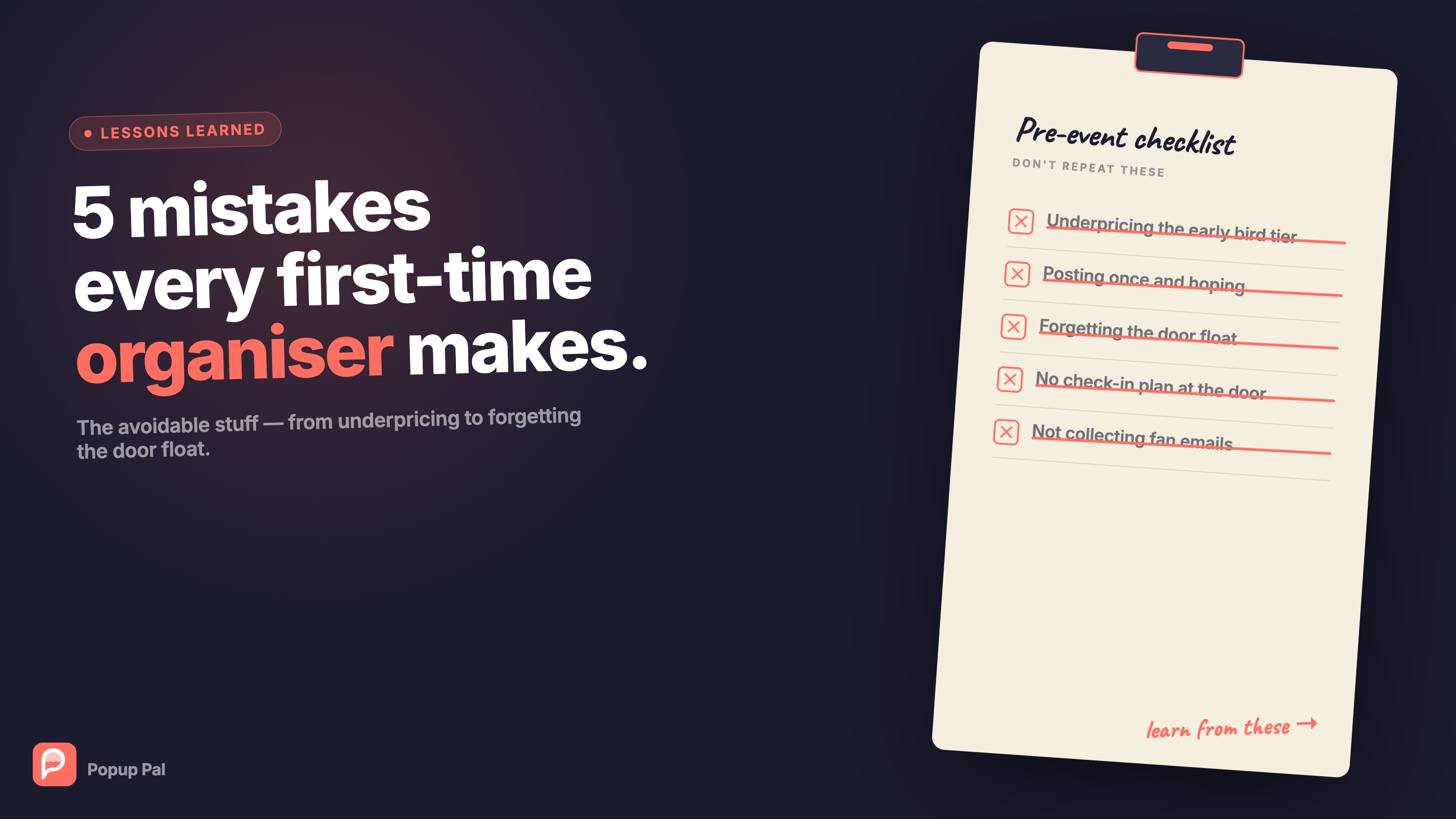
Most first-timer mistakes are entirely avoidable. They come up again and again, and they all have a fix. Here are the five most common ones.
1. Not having a refund policy
The one that catches people out most. You sell 200 tickets, and a week before the event you get a flood of refund requests. Maybe the weather forecast looks grim. Maybe a competing event popped up. Maybe people changed their minds.
Without a clear policy, you end up making it up on the spot, which leads to awkward conversations, negative reviews, and lost trust.
How to avoid it
Set your refund policy before you sell a single ticket, and make it visible on your event listing. Three sensible options.
- Full refunds up to X days before the event. The most fan-friendly option. Seven days is a common cutoff.
- No refunds, transferable tickets. Fans cannot get their money back, they can pass the ticket to a friend. This protects revenue while keeping fans happy.
- No refunds. Fine for cheaper tickets and events with high demand, be upfront about it.
Whatever you choose, state it clearly. Fans are far more understanding of a "no refunds" policy that is stated upfront than one that appears only when they ask for their money back.
Built-in refund tools save headaches
Choose a ticketing platform that lets you set refund policies when you create the event. Much easier than managing refund requests by hand through your bank or PayPal.
2. Underpricing tickets
First-time organisers almost always price too low. It comes from a good place, you want people to come, and you are not confident enough to charge what the event is worth. Underpricing creates real problems.
When your ticket price barely covers your costs, one unexpected expense (a sound system hire, a cleaning fee, a last-minute venue change) can turn a successful-feeling event into a financial loss.
How to avoid it
Work backwards from your costs, not forwards from what you think people will pay.
Step 1. Add up every cost. Venue hire, equipment, insurance, staff, cleaning, marketing, ticketing fees.
Step 2. Divide by your realistic attendance, not your optimistic one. If the venue holds 200, plan for 150.
Step 3. Add a 20 to 30% margin. This is not greed. It is the buffer that keeps you running events instead of giving up after one.
Step 4. Check it against similar events in your area. Dramatically higher, you might need to cut costs. Dramatically lower, you are probably undercharging.
Use tiered pricing to your advantage
Early bird tickets let you offer a lower price to early buyers while keeping your standard price where it needs to be. Group discounts can also help shift tickets without slashing your headline price.
The psychology matters. A £12 ticket that was £10 during early bird reads as a deal. A £10 ticket that was always £10 reads as the true value, and if you ever need to raise it, fans push back.
3. Ignoring marketing until the last minute
The "build it and they will come" fallacy. You spend weeks planning the event, perfecting the lineup, designing the flyer, and then post about it three days before and wonder why tickets are not moving.
Marketing is not a single push at the end. It is a drumbeat that starts the moment your event is announced.
How to avoid it
Start promoting the moment your tickets go live. A simple timeline.
- 4 to 6 weeks before. Announce the event, open early bird sales. Post on every channel.
- 3 to 4 weeks before. Share behind-the-scenes content. Reveal vendors, artists, or highlights one at a time.
- 2 weeks before. Early bird deadline. Create urgency where genuine. Share social proof.
- 1 week before. Practical info push. Remind people what they are in for. Final call.
Do not just post once per phase. Repeat yourself. Most followers will not see your first post. Instagram's algorithm shows your content to roughly 5 to 10% of your audience. You need to say it several times for the message to land.
Let your platform do some of the work
Some ticketing platforms actively market your event for you. Popup Pal features organisers in a curated weekly newsletter, on Instagram, and surfaces them through Poppy, our AI concierge. Active marketing as standard. Worth considering if marketing is the part you struggle with.
4. Choosing a platform on name recognition rather than fit
"We will just use Eventbrite" is the default for most first-time organisers. It is the name everyone knows. "Well-known" and "right for your event" are very different things.
On a £10 ticket, Eventbrite takes 12.9% in fees. On a 200-ticket event, that is over £250 going to the platform, for a service that includes no active marketing, shows competitor events on your page, and holds your money for 5 to 7 days after the event.
How to avoid it
Compare at least three platforms before committing. The things that actually matter for a first-time organiser.
- Fees. The percentage and any fixed per-ticket charge. Calculate the total cost on your expected ticket volume.
- Marketing support. Does the platform help fill the room, or do you do all the work?
- Payout timing. Can you access your money before the event, or are you waiting days or weeks?
- Audience ownership. Do fans follow you, or the platform? Can you contact past attendees for future events?
- Ease of use. Can you get an event live in under fifteen minutes?
The right platform for a 10,000-person festival is not necessarily the right platform for a 150-person comedy night. Choose the tool that fits your scale.
5. Not collecting fan data for future events
Your first event is not a one-off. It is the start of your audience. Every person who buys a ticket is someone who might come to your next event, bring friends, and become a regular.
Too many first-time organisers treat ticket sales as a transaction and nothing more. They do not collect emails, they do not encourage people to follow them, and when it is time to promote the second event they are starting from scratch.
How to avoid it
Think about your fan data from day one.
- Use a platform where fans follow you. They get notified about your future events automatically. Far more reliable than hoping they see your Instagram post.
- Collect emails. Either through your ticketing platform or a sign-up at the door. An email list you own is the most reliable way to reach your audience.
- Export your data. Make sure you can download your attendee list as a CSV. Some platforms restrict this or make it difficult. If you cannot export, you do not really own it.
- Send a follow-up. After the event, email the people who came. Thank them, share photos, tell them about your next event. The conversion from "attended one event" to "bought tickets for the next" is high.
Building an audience is a compound effect. Your second event is easier than your first. Your fifth is easier than your second. Only if you have been collecting and nurturing your fan base from the start.
The common thread
Look at these five mistakes together and a pattern emerges. They are all about planning ahead rather than reacting in the moment. Set your refund policy before you sell tickets. Price based on costs, not feelings. Market from day one, not the last week. Choose your platform on fit, not familiarity. Treat every ticket buyer as the start of a long-term relationship.
None of this is complicated. It just requires thinking about your event as a business, even when it does not feel like one yet.
Built for every event. Designed for every organiser.
Refund policies, early bird pricing, fan following, and active marketing as standard. Everything first-time organisers need, in one place.
Create your event